The change that I will be discussing today is a bit unusual, which is part of the reason I picked it. As part of the LGBTQIA+ community this change feels very timely and one we will see more of. Also, as someone without a background in Human Resources, it was exciting for me to examine how other departments handle a change like this.
Like in most cases I know of, HR policy changes can be reactive to an environment shift and this example falls into that category. However, it wasn’t a member of HR who drove this change but rather the personal test case. As we know from the adaptive change definitions “People with the problem do the work of solving it.”
Jen Henderson is a highly accomplished tech nut. She has held titles such as Regional Director of Technology, Senior Software Engineering Manager, and Senior Vice President -Data Group Manager, Corporate and Institutional Banking. She is also a graduate of Rose-Hulman Institute of Technology, where our good friend Marshall Goldsmith also graduated.
In addition to her professional background, I’m going to talk about an area we usually wouldn’t, but it’s extremely relevant to our story. Jen Henderson was not born as Jen. She was born biologically male and passed as J.J Henderson at work.
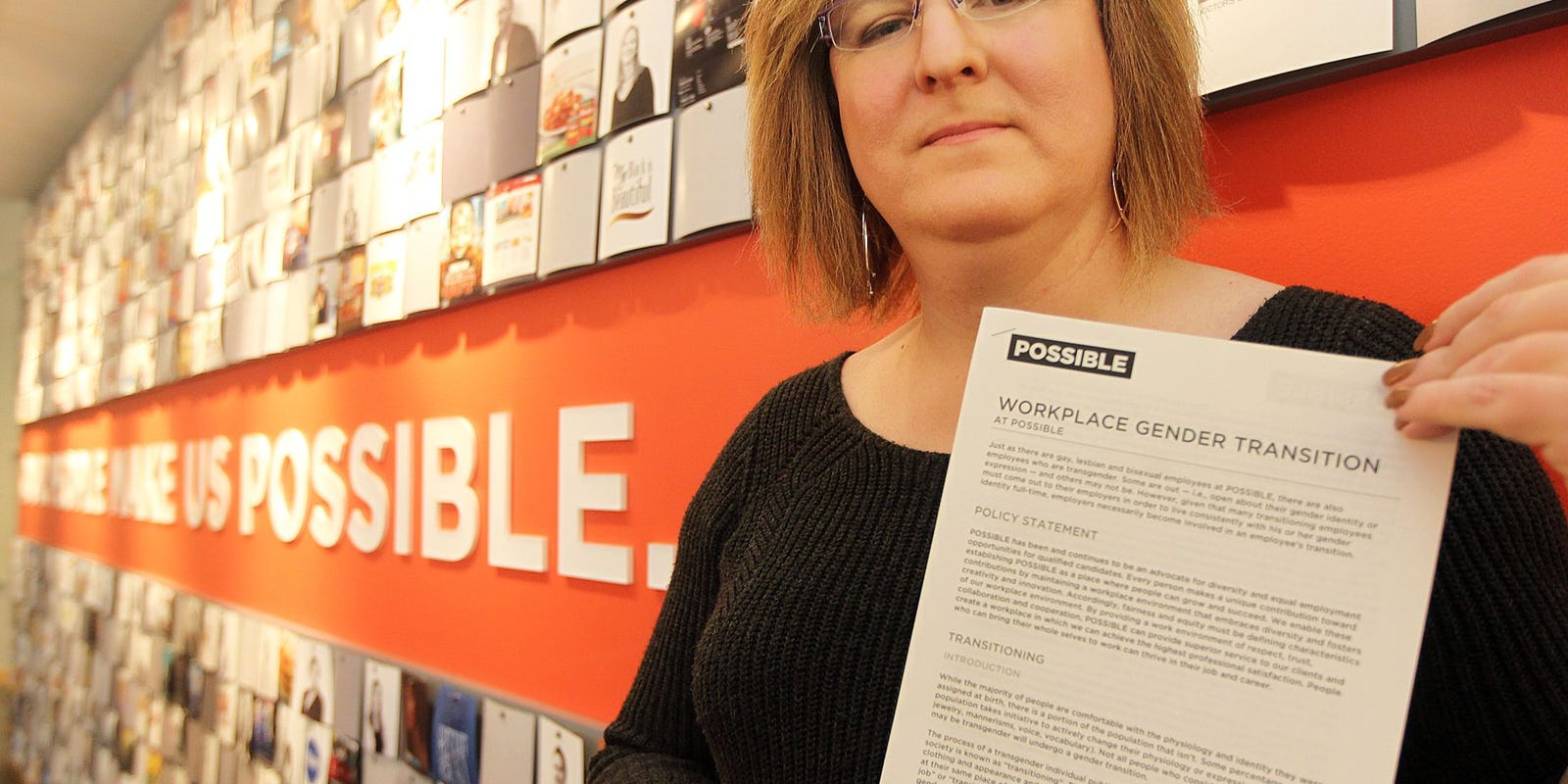
When it came time to change jobs, Jen sought out companies that ranked well on the Human Rights Campaign’s Corporate Equality Index where she found a marketing company named Possible. Jen intended to finally do an on-the-job transition. So, she reached out to the HR department to find out what the policy and procedures are and found none. Not with Possible, nor its parent company WPP, even though one of WPP’s divisions did work exclusively for LGBTQIA+ campaigns.
Jen created a Wildly Important Goal. Rather than work with her team, the Possible HR, and WPP to find a way for her to personally transition, she wanted to create an HR policy that would pave the way for all other employees who came after her and sought to transition.
Several areas could have thwarted her effort completely. As we know, culture can eat strategy for breakfast. At that time the nation was beginning to talk about bathroom bills and attacks on transgender people were on a rise. So, was the culture prepared for what she was trying to do? If not, the transition management would be full of discomfort and uncertainty and possible personal harm.
People who Jen talked with were in different places. One of her bosses met the news with genuine excitement. “He was dead silent for a second, and I was frightened. I thought I had made a big mistake. Then he grabs my arm and says, ‘That is freaking awesome. We need more women in technology.’”
The situation was quite different with another boss. “I was informed – somebody from outside the company had told him, had outed me, and I wasn’t quite prepared for it, but we went ahead with it. In my next one-on-one with him, I let him know that I knew that he knew. He said, I don’t really know what this is, but I’m willing to learn and I’m here to support you, so let me know what I need to do.”
Additionally, as part of her day to day work, Jen worked face to face with accounts that were known to be conservative, such as Smucker’s. For a while, men were not allowed to have facial hair on their main campus and Possible had been given specifications that a man and a woman in the same shot had to be wearing wedding rings.
Jen is definitely a rider but clearly understands the needs of the elephant. This can be seen in the presentation she created for her team. She describes it in this Adweek excerpt.
“I begin the presentation.
My home life is unique, I say. Click. Slide 1 is a photo of my kids. As I talk about them, it’s clear how proud I am. The typical beaming dad. I go on. We celebrate an unusual holiday at my house—a holiday the kids made up. Click. A calendar appears, with March 24 marked as “Maddy’s Day.”
My kids invented the word, “Maddy,” I explain. It’s a blend of Mom and Daddy because we don’t celebrate Father’s or Mother’s Day. Click. The next slide, another photograph, shows me with my children. It’s not the version of me most people in the room know.”
“The photo—that “big reveal”—shows me in my kitchen, surrounded by my kids. With my hair in a long bob, I’m dressed as the woman I have long known myself to be.
The room erupts in applause. People hug me. They congratulate me. The next day, I show up to work as Jen. And an amazing thing happens—nothing.”
Jen did an amazing job of helping everyone find the feeling on her team and rally the herd. She understood that the elephants of her clients and co-workers needed to be met, including how to handle possible confrontation to keep clients happy. They started by sending a press release to their customers explaining what’s happening.
“A couple of days later we did a Trans 101 for the people who were in my office. One co-worker wanted to know what to do if “one of my accounts are just really not comfortable with Jennifer anymore?” I stopped the conversation and said this is my own answer. My own answer is this, we’re in the advertising business and our customer support is what we are here for. We have certain customers who don’t like people who work here because they don’t like their sense of humor, they don’t like how they dress, they don’t like how they did that last ad for them. They have all sorts of reasons why they don’t want to work with a particular person. If someone comes to you and says they don’t want to work with Jen anymore I will be sad, I will be disappointed, but I’ll find someone on my team to handle the account. That’s their problem. What I showed was that my needs to be accepted by our clientele were not the overriding factor. It was my need to be me and the authentic me which was what was important in the interior of the company.”
This also helped script the change not only for Jen but for the company at large. Clients are going to dislike the people they are working with for lots of different reasons. Don’t let it become an issue for the client, and don’t let it become an issue for the employee. Move both on to a better situation that meets their needs.
When it came to the riders, Jen looked at things in a very practical manner.
“We gathered some material from some other Fortune 500 companies to see the general legal framework, and then we broke it down. … Some of them were sort of dated in their language and their terminology. Some of them were quite legal oriented, which is not what we were trying to do. What we were trying to do is create a framework for both the managers and the individual. I was working with HR. We were starting to come up with some sort of semblance of a time frame for me (to transition on the job).”
They also investigated the financial costs. After an analysis came back showing that the worldwide output would be under $5 million, a drop in their health care bucket as Jen said, “The financial worry is not there so the argument for not doing it gets weaker and weaker.”
This change is a unique example where the change agent is also the case study. So, Jen in many ways is the bright spot for the future success of the HR policy. The immediate use of her preferred name and pronouns was a huge and quick bright spot. Her co-worker’s insistence that she stop using the far away bathroom for their comfort showed how the company and Jen had already grown the people.
Besides these internal bright spots, there were also external. Jen was asked to be co Grand Marshal of the 2016 Cincinnati Pride Parade. The Cincinnati Enquirer did a story on her and she wrote articles on the change for Adweek and Huffington Post.
Jen didn’t need to create a sense of urgency because it already existed. Not only was it time for her to live as herself both personally and professionally. But she had started a medically supervised transition which would change her appearance significantly, including the shape of her face.
The vision of the HR department and Jen was to create a policy and procedure that covered every aspect of transition, from medical coverage to “coming out” to their co-workers. It was very important to Jen that she created a policy that not only worked for her but for all that came after her and their specific needs. As Jen said, “Firstly, the document clarifies rights: as a transitioning individual at POSSIBLE, you have the right to openly be who you are. While maintaining professional expectations, you may express your gender identity, characteristics, or expression without fear of consequences.”
Enable action by removing barriers – I have a different way of thinking about this idea in this example. By coming out as herself, Jen created a psychologically safe place not just for herself but for everyone at her company. They created a glossary of terms to help shrink the change. Not everyone was expected to be an expert on the first day. They also worked with a local organization to hold a Q & A with people who work in the LGBTQIA+ space. Jen excused herself from the sessions that people felt comfortable asking any questions.
The policy was first instituted at Possible in Cincinnati and then adopted by WPP for all its division globally, covering 170,000 employees. To help sustain the change created, she approached it as “its more than just about me. It was going to be for people who might do this in the future”. Which it has. Six months later, another employee transitioned at their Denver location using the policy. Jen started receiving calls from each employee who was started their transition. Since Jen created the policy and living out being a case study, an estimated 25-30 people have transitioned using the policy.
As I’m gearing up to lead my adaptive change at work, Jen has given me a lot to think about. First off, she reiterated how important it is to have the receptionist as part of your guiding coalition, something we’ve talked about in class. They know everything and can make or break a change.
She also taught me a lot about how to be your authentic self in your professional world and how important it is. Her actions built a sense of comradery and showed the equity of the workplace, which we know is important for employee engagement. Everyone became more productive and more excited about their work because they knew it was a place where they could truly be seen for who they are and what they brought as an individual.
I will need to rely on Kotter’s framework more than she did but I also have a better understanding of how psychological safety can make change a celebration and allow each employee to bring their full self to a workplace, making it a better and more productive space for all.
Citations
Creasey, Tim. “Checklist for Your Change Management Approach.” Prosci, blog.prosci.com/checklist-for-your-change-management-approach.
“Engaging Today’s Workforce: Insights from 25 Years of Research.” United States, www.mercer.us/our-thinking/career/engaging-workforce-insights-from-research.html.
Henderson, Jen. “How My Gender Transition Helped Create a Path for Future Agency Employees.” Adweek, Adweek, 5 May 2016, www.adweek.com/brand-marketing/how-my-gender-transition-helped-create-path-future-agency-employees-171273/.
Henderson, Jen “J.J.”. “Writing the Policy to Transition on the Job.” HuffPost, HuffPost, 7 Dec. 2017, www.huffpost.com/entry/writing-the-policy-to-tra_b_10030980.
“History.” Cincinnati Pride – June 22, 2019, www.cincinnatipride.org/history.html.
Lahey, Robert Kegan Lisa, et al. “The Real Reason People Won’t Change.” Harvard Business Review, 10 Nov. 2015, hbr.org/2001/11/the-real-reason-people-wont-change.
“Our People.” WPP Sustainability Report 2017/2018, sites.wpp.com/sustainabilityreports/2017/our-people/#diversity-and-inclusion.
Saker, Anne. “Writing the Policy to Transition on the Job.” Cincinnati.com, Cincinnati, 15 Mar. 2016, www.cincinnati.com/story/money/2016/03/13/writing-policy-transition-job/81274496/.
“The 8-Step Process for Leading Change.” Kotter, www.kotterinc.com/8-steps-process-for-leading-change/.

 MarketingMichelle