Leading While Female: Being Undermined in the Workplace

Photo by Ashley Jurius on Unsplash

The event was already off to a rough start. Even though I had meticulously ordered from the venue so that the wide variety of dietary issues could be met WITHIN the budget, someone had decided to make some changes and now I had hungry vegans on my hands. But as a veteran of running events I was used to these sorts of day-of fires and after consulting the owner had everything in hand. The day was important to me. I had reached a point in my career where my resume didn’t reflect what I was capable of doing, what I was doing regularly. I need to be able to add some credentials that reflected my worth.

 So, when the Evanston Chamber of Commerce put out a call for committee members for the Women in Business Lunches, I gladly signed up. I had attended several lunches and saw the need for a little more organization, a little more foresight. The first few meetings were excruciating. A revolving door of new committee members showed up each time only to realize that the work to fun ratio wasn’t what they were expecting. At some point I became the only constant and spent each meeting recapping to the new members what had already been decided. So, after agreeing to host the May meeting, I planned to make a graceful exit. I focused my energy on creating an event I would be proud of and could proudly add to the resume before going back to “normal life”.

I attempted to leverage our proximity to Northwestern University, contacted multiple faculties members about putting together a lecture on how women unconsciously police their language and what we could do to change it. Sadly, no one felt like an expert on the subject. Eventually I was put into contact with Lynne Franklin and we created an interactive set that I thought would be great. With local restaurant Bat 17 on board, part of a strategy to warm them up for possible donations for future fundraisers for my nonprofit employer, we were set.

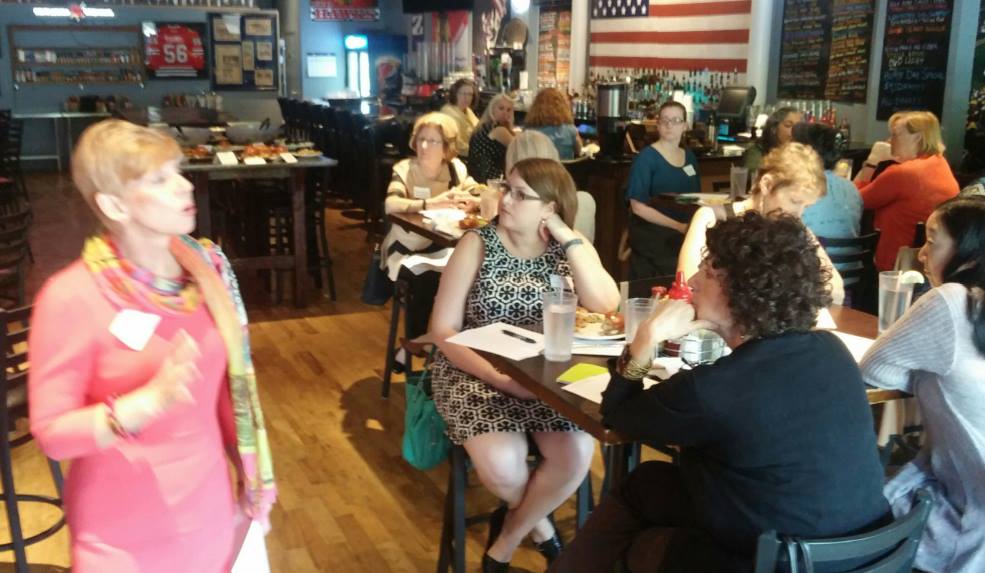
The hungry vegans aside, the event was going well. Lynne was teaching us how we could change any question we got into an answer that we wanted to give, and I thought people were enjoying themselves. I was starting to make that mental transition from host to participant when he walked up. The only man in the room, he was the brand-new assistant to the President of the Evanston Chamber of Commerce and was there to assist with registrations at the door and such. Other than a cursory “hi hello” when I first walked through the door, I had been too busy managing the event to connect with him. But this man would end up leaving an impression that still bothers me to this day. There are times that I wish I could erase what he said from my memory.

“My goodness! What horrible thing did he say?” you must be thinking. Another lesson in how ordinary words can hurt when uttered by the well-meaning. “I’ve taken several pictures of the event for us to put on Facebook,” he whispered in my ear as he interrupts my partner and I practicing of our new skills. “How wonderful” I exclaimed before turning back. He continued to hover. It took a moment before I turned back to him, confused about what more he needed from me. “I’m not sure I should post all of them. They might not be appropriate. You are showing a lot of leg.” By reflex I looked down at my lap confused, maybe thinking that something had hiked up without me realizing. But my dress was in place and my legs were still my legs. “Would you like me to show you the pictures so you can decide if you want them deleted?” In somewhat of a daze I nodded. He held up his digital camera that was out of date for 2017 and showed me picture after picture of women seated at high tables chatting. I waited to see something horrifying and never did. “They’re fine,” I stated. “Are you sure?” “Yes, please post them all on Facebook right away.” He finally left.

I tried to return my attention to my partner. I tried to fully engage with all the networking happening around me. With the congratulations on a successful event. I was happy when the owner, pleased at all the new business he expected from the packed event told me not to worry, that he would have his staff straighten everything up. I drove back to work in a bit of a daze, luckily, I didn’t have far to go. I wasn’t quite ready to sit at my desk and plug myself into the computer and check my email as if everything was fine. I noticed our professional students using the gym and took a detour to spend a few minutes watching their progress. A friendly bunch they greeted me as I walked through the door. And then one of them, hanging from the ceiling, rang out “why are you so dress up” and the rage that I had been trying to suppress exploded from my body. I told them about the horrid man and my legs which I was now looking at as if they had betrayed me. The women in the room, versed in these situations in their own lives responded with disgust and swiftly came to my defense. But that old and dirty friend doubt had already wormed itself in. I hadn’t been sitting very ladylike, no crossed legs. I had crossed my legs at the ankle, letting my legs splay out a bit. And I was sitting at a rather tall table, maybe the angle had made things indiscreet and I had been too stupid to realize? I sat in one of our chairs to recreate to check myself.

It was one of the men in the room who helped to undo some of the damage of the first man. A little confused he asked, “wait, have you changed?” “what do you mean?” “have you changed outfits? Were you wearing something else?” “No, this is the dress.” “THIS is the dress? Wait, what? I thought you had to be wearing something shorter. That’s just a dress. Those are your legs. I don’t understand?” Like that my doubt was whisked away. Yes, this is a dress. A dress that my mother bought for me. One that I had worn to a wedding. One that I had worn to several professional and important occasions. And these were my legs. Legs that walked me around my beautiful neighborhood. That helped me climb the ladders around our gym to move around merchandise, to rearrange equipment before open houses, that carried me through life.

What saved me was our student’s complete confusion on how the heck someone had judged my body as inappropriate. This was new to him but terribly familiar to the women in the room. That familiarity had worn a path that let doubt in. His naivete to these familiar experiences helped right my perspective. I was able to go back to work, though I have no memory of what I accomplished. I do remember walked home that beautiful May evening, feeling empowered again and a tad righteously angry when a woman I had never seen in my life passed me on the street and called out, “What a beautiful dress!” It felt like a movie moment. I went home and posted about it on Facebook. This week my Facebook memories reminded me of the event.

I’ve grown in confidence a lot since then. On a few occasions, I’ve even confronted people when situations like that have happened again. But mostly I’ve learned how to create an environment around me that doesn’t nurture that culture. That isn’t to say that things like that don’t happen. Whether it’s the blog meeting where we were developing a list of questions to put to our female engineers for the upcoming International Women’s Day post and the men at the table joked about asking them their favorite recipes. Or the time my peer told me that I needed to calm down when I sighed in frustration about a difficult project that was being discussed.

But I’ve learned how to make it inhospitable for doubt and instead take action. I was happy to co-host our location’s first International Women’s Day. Pleased to see the room full of women who turned up to talk about our company’s policy of parental leave and our parent company’s report of pay inequality. Excited that our male head of HR joined us and enthusiastically listened and asked thoughtful questions. Encouraged by my male counterpart who came and asked questions about how he could make sure that his three sons who were just joining the workforce could be part of the solution, rather than the problem.  Found laughter when I offered to host the International Men’s Day event where we could talk about the real and serious issues of work stress leading to chronic disease, offered to buy them flowers and chocolates or the beer and soft pretzels they asked for when one of the men piped up to say, “Michelle, let’s be honest. Every day is men’s day. We’ll be fine.” I’ll continue to lead wherever I can and try to make life better for those around me each time. I’m sure there will be many more instances of my gender being brought up in business situations. So, I’ll continue developing the skills needed to lead while female. 
A Reflection on “Everyday Leadership” Tedx Toronto with Drew Dudley

Photo by Ian Schneider on Unsplash

For so many people, the definition of a leader is “one who is in charge or in command of others”, as my American Heritage College Dictionary implies. I saw it on my first day of Leadership Practices and Principles class when the professor asked us to separate ourselves into a group that believed that they were leaders and a group that believed they weren’t. It was amazing to me to watch half of a group of people taking a leadership class publicly declare that they weren’t leaders. I think that’s why the Tedx Talk “Everyday Leadership” with Drew Dudley resonated with me so much, as that’s the first concept he talks about.

I grew up in a Catholic church that wasn’t like any of the others. Some viewed it positively as ‘one of the most vibrant parishes in the United States’ while others used phrasing like ‘the lesbian aunt of the Catholic family’. I had a priest who believed that women should be able to become priests, that priests should be allowed to marry and have children, and so many other ideas that were considered heretical by some. Above all, he espoused and taught us the concept of servant leadership.

It’s an idea that first sprung up in the 1970s. One description is as follows, “the servant-leader is servant first… It begins with the natural feeling that one wants to serve, to serve first. Then conscious choice brings one to aspire to lead. That person is sharply different from one who is leader first, perhaps because of the need to assuage an unusual power drive or to acquire material possessions…The leader-first and the servant-first are two extreme types. Between them, there are shadings and blends that are part of the infinite variety of human nature.”

It was woven into our faith practice. On Holy Thursday, when we read about Mary Magdalene washing Jesus’ feet and drying them with her hair, we followed that up with the entire parish taking part in a foot washing. We lined up as if for communion but instead, when you got to the front of the line, you sat in a chair, removed your shoes, and had your feet washed by the person behind you in line. Then that person took your place and the person behind them washed their feet. Though I’m now a lapsed Catholic, it’s a memory that sticks with me.

To me, a leader is someone who uses small acts in everyday life to make better the world of people around them. When it becomes a practice that informs every decision you make, you don’t always remember the act that affected someone else’s life, like the lollipop example that Drew shared. I have had moments like that when someone has thanked me for something I don’t even remember doing.

For years, when I worked in the film industry, I put together a newsletter of opportunities I knew about and shared it with my actor friends. It eventually grew to the size that I had to start using Mailchimp instead of my personal account and people subscribed in the thousands. Many asked why I didn’t charge for access to it but that was never the point. I knew the frustration of being a casting director trying to get the word out about a production. I knew about the frustration of being an actor discovering an exciting production after they concluded casting. To me, I was trying to close the gap to help everyone. I didn’t realize the impact of it until I was at a fundraiser for the Chicago Acting in Film Meetup and was cornered by two ladies who I had never met before. They told me that they had qualified for their union cards because of work that I told them about. It was an amazing and humbling moment. Something I did because it made me feel good had substantially changed the lives of women I had never known existed.

I still wouldn’t have thought about that as leadership at the time. I often think of myself as the connector. I see a need and a solution, and I insert myself to introduce them to each other. I too struggle with the idea Drew talks about as leadership as something we will one day achieve and deserve. To me, a leader is someone charismatic. Someone who has a lot of Influence on the DISC scale. Not someone like me with a 6 in Influence and at 28 in Compliance and a 33 in Steadiness. That sounds like a great secretary, not the visionary who changes the world as we know it.

I even denied it to myself when others would point it out to me. I had worked at The Actors Gymnasium for 3 years when my boss left. I assumed that a replacement would be found for her and fretted about having the leeway I enjoyed getting things done. I was quite surprised when our Executive Director informed me that I would be the replacement. She told me that they would never be able to hire someone from outside to do as good and as passionate a job as I was already doing. I still doubted myself. I thought it was a promotion out of convenience as much as anything. I was even more surprised two years later. After letting us know that she would be leaving as she and her wife were moving to Atlanta, my Executive Director took me aside and told me that it was time to leave. I thought she was firing me when she was trying to tell me that I had outgrown the organization and was becoming much too big a fish in way too little of a pond. The day I left, she gave me a framed copy of the Marianne Williamson quote that Drew shared.

I remember the first time I felt leadership. Without this moment, I would have never considered myself for this program when I heard about it. Like hundreds of thousands of women in Chicago, I showed up to the Women’s March in January of 2017. Since it was my first protest, I had done a lot of research to make sure I was prepared and even learned a few of the chants. It took a long time for that march to start moving. That will happen with a crowd of 250,000 people. We eventually started moving and I was swept up by the excitement of the crowd and the chants. The moment that I will never forget is when I started a chant and thousands of people picked it up. There truly isn’t anything like it. I understood for the first time the power of my voice and my passion. It’s the first time I gave myself credit for leading. It was exhilarating and made me want to use my voice every opportunity that I get.

I’m learning how to weave together my voice and my servant leadership. It’s taking part in further protests. It’s making sure that the faces on a marketing brochure are predominantly people of color. It’s adding pronouns to my email signature even though I’m not transgender so that I can start the conversation. It’s making sure that everyone in my group in Business Writing has a chance to be heard. It’s about me sharing my struggles during lunches so that people know that they aren’t alone. Its writing people on Facebook about the lollipop moment that they did for me. It’s about using humor to break down walls. It’s about listening so that others can feel seen and heard and backing marginalized voices. Sometimes the best way to lead, is to support. I’ve learned a lot about how to communicate ideas in my Northwestern Business Writing class, and I’ve learned so much about how I and others tick from Leadership Principles and Practice. But I’ve also been confirmed so many times in the idea that a leader is someone who listens. Who shares kindness. Who is empathetic. Who recognizes the best idea in the room especially when it wasn’t their own. This may be a different definition of leadership than what most believe, but it is a definition I not only believe but am learning to become.

Are Introverts Smarter than Social Psychologists? Critical Thinking

Are you as smart as a social psychologist? If you are an introvert you might be. So claims the study “Social Psychological Skill and Its Correlates” by Anton Gollwitzer and John A. Bargh. Or does it? According to the Inc. article covering the study titled “Yale Psychologists: Introverts Are Better Than Extroverts at Performing This Essential Leadership Skill” by Glenn Leibowitz, introverts as opposed to extroverts, were better at “observing and understanding the social behavior of people in group settings”.

However, I believe there is a flawed premise of the article – that being that the study and the article do not share the same meaning for the word introvert. You would think that I would be calling into question the way that a consumer-minded organization uses the word. You would be wrong. I believe that Inc. is using the definition of introversion as defined by the American Psychological Association (APA) as:

introversion

  1. orientation toward the internal private world of one’s self and one’s inner thoughts and feelings, rather than toward the outer world of people and things. Introversion is a broad personality trait and, like extraversion, exists on a continuum of attitudes and behaviors. Introverts are relatively more withdrawn, retiring, reserved, quiet, and deliberate; they may tend to mute or guard expression of positive affect, adopt more skeptical views or positions, and prefer to work independently. [concept originated by Carl Jung for the study of personality types] —introversive adj. —introvert n. —introverted adj.

What very little definition that Gollwitzer and Bargh share for their definition of introversion focuses on a single word – loneliness. As is attested to by the Psychcentral article “The Link Between Introversion and Loneliness” there is a complexity of “delightful alone-ness to fretful loneliness”. Our definition source for this paper, the APA suggests this:

loneliness

  1. affective and cognitive discomfort or uneasiness from being or perceiving oneself to be alone or otherwise solitary. Psychological theory and research offer multiple perspectives: Social psychology emphasizes the emotional distress that results when inherent needs for intimacy and companionship are not met; cognitive psychology emphasizes the unpleasant and unsettling experience that results from a perceived discrepancy (i.e., deficiency in quantity or quality) between an individual’s desired and actual social relationships. Psychologists from the existential or humanistic perspectives may see loneliness as an inevitable, painful aspect of the human condition that nevertheless may contribute to increased self-awareness and renewal. See the UCLA Loneliness Scale.

Loneliness isn’t exclusive to introversion. Introversion does not necessitate loneliness. So from an early point in ready the study, I began to have large questions about the validity of the study and also about the different ways that we interpret introversion especially when dispensing business knowledge as in the Inc. article.

This probably is influenced in part by the fact that I am an introvert. I was having trouble finding a study that captured ideas that I was interested in, such as the importance of art in developing empathy and imposter syndrome, so imagine my delight when I, an introvert, found this Inc. article by simply typing in “new study finds” and “social behavior” into google. Being an introvert is an inescapable part of how I function in the world, so I of course wanted to learn more about a business skill I may have that others don’t. It also explains why I take except to the idea that the main association for these scientists with introversion is loneliness. Many introverts have spent many a conversation with an extrovert trying to explain the difference between being alone and being lonely. Just google “introvert alone vs lonely” and you’ll see that we have quite a bit to say on the topic.

If I were the Inc. article writer, I may have been better served to say that loneliness and low self-esteem are linked to better ability to predict social psychological phenomena. If I were the scientists in the study, I may have been better served to find a different word than “introvert” to describe the behavior I was intending. It was also interesting to see that they are familiar with the cultural ideal of “introvert” as they used the word introspective, which is more descriptive of an introvert’s behavior than a possible side effect or symptom that is loneliness. Again, returning to the APA, we get this definition of introspection as:

introspection

n.

  1. the process of attempting to directly access one’s own internal psychological processes, judgments, perceptions, or states.
  2. in the literature on attitudes, the process in which a person attempts to explain the reasons for holding a particular attitude, reaching a specific decision, or engaging in a particular behavior. —introspective adj.

But suggesting that business people have worse confidence in themselves in order to have more confidence in their ability to predict social psychological phenomena such as social loafing and attribution effects probably doesn’t fly with their editor. Another way to frame it which also wouldn’t have been as exciting but more accurate to the study would be to share that taking a single class in psychology would significantly weight your ability to predict such behaviors.

I’m quite disappointed to say that I don’t hold water with the claim made by the study and trumpeted by the Inc. article that my introversion makes me better at predicting social psychology behavior or at understanding behavior in group settings. In large part because both sides are playing fast and loose with terminology. Between the Inc. article grabbing onto the buzz word of “introvert” and extrapolating what it meant about observing group behavior, a conclusion that I believe it drew from the mention of social loafing in the study and nothing else, and the scientists using a personality type, introvert, as a stand-in for a feeling, loneliness, and low self-esteem there’s little left to shore up the conclusions drawn by both sides.

Citations

APA Dictionary of Psychology. (n.d.). Retrieved from https://dictionary.apa.org/

Asatryan, K. (2018, July 08). The Link Between Introversion and Loneliness. Retrieved from https://psychcentral.com/blog/the-link-between-introversion-and-loneliness/

Gollwitzer, A., & Bargh, J. A. (2018). Social Psychological Skill and Its Correlates. Social Psychology,49(2), 88-102. doi:10.1027/1864-9335/a000332

Leibowitz, G. (2018, December 31). Yale Psychologists: Introverts Are Better Than Extroverts at Performing This Essential Leadership Skill. Retrieved from https://www.inc.com/glenn-leibowitz/yale-psychologists-introverts-are-better-than-extroverts-at-performing-this-essential-leadership-skill.html

A Reflection on My Leadership Styles

Photo by Alexander Grey on Unsplash

Of the six styles featured in Leadership That Gets Results, what is your primary default leadership style? 
Coaching is my strongest. Weirdly this comes from all of the reading I did as a kid. I feel like I’ve read all of the wrong ways to do things and what has worked. One of the things I miss most about my old job was my assistant Veronica. She was straight out of college and we would have weekly check-ins. She reported to 3 of us but I was the only one who took time to work with her and figure out what her strengths were and what areas she was looking to develop. We would talk about upcoming projects and in addition to those I would assign, I’d ask her to pick a project she wanted to take ownership of, and then we would work closely together with her using me as a springboard for ideas. I would talk to her about setting up behaviors now for the career she wanted in three years, five years, etc. She was delightful and I miss her a lot.

What did you learn about yourself from the DiSC profile? 
Something that didn’t strike me until after we talked about it in Business Leadership class is the fact that I’m pretty evenly divided across three types. That can contribute to some confusion and self-doubt I have when in situations and I feel like I can go in multiple directions. I need to find a way to frame it as an asset for myself. It also was no surprise that I was so low on Influence, an area that I am constantly working on. But maybe I need to realize that I don’t need to be good at every type, but find out ways to use the ones I’m good at to shore up perceived weaknesses in Influence.

What did you learn about yourself from the Harvard IAT test? 
I was quite surprised to realize that I was strongly oriented towards young people. I thought it would reveal older people or at least be middle of the road. Upon examination though, I’m thinking about how many issues we are dealing with as a country that was created under the leadership of older white straight cis affluent men and it makes sense that I’ve developed a bias as an outspoken woman who demands change.

Identify one area of strength and one area to focus on from the Emotional Competence Framework
My area of focus, which also ties into my DiSC, is working on persuasion. I’m great at collaborating but can’t be effective if I haven’t persuaded others to come along for the ride with me. This issue can often butt up against one of my strengths in Innovativeness. Every time I look at an issue, I come up with pages of ideas and solutions. Then work hard to think about what is achievable and what isn’t. So when I’ve done that work and come to a team that meets me with an immediate “No”, I feel incredible frustration.

Share a situation at work where you feel you could be more effective if you honed your EQ. 
Self-confidence in seeing that my needs are being met. I have a boss who hasn’t done any training with me and I’m 2 months into the job. I consider myself a self-starter but you also need to know what there is to start. So finding a way to make him feel comfortable communicating with me is important.

Why Bother Getting A Degree Now?

Photo by MD Duran on Unsplash

For people of my parent’s generation, college degrees equal money and power. Don’t get me wrong, acquiring both of those things would be lovely. But that isn’t the reason that I’ve committed myself to spend every other Saturday for the next two years of my life in a room with the same group of people. I did it to show myself that I can.

I love to learn but school has always been a struggle for me. Failing to get my degree has always been a matter of pride and a personal struggle rather than a professional one. Yes, I did notice how difficult it was in 2018 to get to the next round while unemployed and looking for a job. But I’ve always had a knack for proving to potential employers that I’m worth the risk and pulled it off once again. So yes, it will be nice to clear that hurdle effortlessly in the future. But what I’ll take the most joy out of when I cross that stage is the fact that I decided to do something FOR ME and followed through. I’m happy to give my time, attention, and other resources to help others. I have a high failure rate in doing the same for myself. To set a personal goal and achieve it, going through all the tough times and the stress, coming out triumphant will help repair a big wound in how I see myself. 

I also expect that it will do great things for my self-esteem in work situations. My fake it ‘til you make it muscles has grown very strong from constant use. It would be nice to not fake, but intrinsically know.I’m a big fan of the saying, “You don’t know what you don’t know” because I don’t. I don’t know if the skills I feel weakest at are taught as part of a degree. I don’t know if the lingo being tossed around is something common amongst graduates. I don’t know if there is a key concept that would make the business strategy more effective that I didn’t learn in a 101 class. So, I’m excited to fill the gaps of my knowledge or to discover that there is no secret behind some things just an instinct acquired after years of working in an industry. 

I may not aspire to a fat bank account or world domination; however, I do have a dream that I’d love for the program to help me turn into a reality. My dream job is to get into a local arts organization like a Goodman Theatre or the Art Institute at a leadership level. I want to change the narrative around women, people of color, and queerness. We logically know that each of these groups existed before now but act as if all trace of them has always been invisible until the modern-day. That is just not the case. I want to put large amounts of resources towards rediscovering these stories and making them part of the normal background of our cultural education. My hope is that one day, these stories will be old hat to students, a normal and boring part of their education. What they won’t know is how dynamically that would change the world. So, I guess I do want world domination after all.  

Looking Fear in the Eyes: Going Back to School

Photo by Tonik on Unsplash

Statistics. Oh Statistics, how I fear you. Starting in 5th grade I suddenly went from categorized as “good at math” to “struggles with basic concepts”. I’ve often wondered how this came to be. Was it the chicken in that my teacher wasn’t very good at explaining the ideas of pre-algebra to a bunch of 10-year olds and the game was lost at that point. Or was it the egg, that I had never really had an aptitude for math but instead parents who worked hard to teach me math concepts until we hit the level where they also had issues. Whatever the case is, as soon as we start speaking about math, it sounds like someone has accidentally switched the tv channel inside my brain to the static channel and the voices sound like the adults in the Peanuts. So, when I was applying to this program and saw statistics, my heart sank. However, I am now old enough, wise enough, and have the financial capabilities to seek help. I’ll, of course, start with the free help offered at The Math Place. I’ve also been lucky enough to make connections at a Fusion high school which has offered one on one classes in math if I should need. This trepidation includes the accounting and financial classes that are part of the curriculum. I am lucky enough that when I was promoted at a previous job and asked what areas I was most concerned about, I mentioned budgeting, so I’ve had some pretty hands-on help in that area.

There are two other classes that may play into my weaknesses. One is Organization Behavior 398-B where we will learn about career soft skills, especially branding. I truly hate talking about myself. When I changed jobs in 2018, the worst part was having to write my resume. Puffing myself up, branding myself makes me feel like I’ve eaten worms for breakfast. I love to let my work speak for me, and times, when I must speak about myself, are excruciating.

The other class is one I am taking right now, English 205. I love to read. I love the English language. If I could retire now and spend the rest of my life reading as many of the published works in the world as I could, nothing would make me happier. So, it’s completely strange that I freeze up every time I try to take a Composition class.  I’m fortunate in how open Leslie is to the needs of her students. Her belief in me has gone a long way in allaying my fears and offering a glimmer of hope.

As for strengths, I’ll confess that I applied to this program in part because so much of it is work that I’ve taken part in in the past. I’ve been lucky enough to take the League of Chicago Theatre’s full-day seminar on Leadership and Conflict Resolution. As someone navigating a life full of characters with their own issues, I’ve always been fascinated by what makes other people tick. Having my father own a consulting firm in our home and a member of Jim Higgins & Associates since 1994, I’ve long speculated at how work that pleases one company will leave another flat. The course I am looking the most forward to is not Introduction to Marketing, though that is my field, but the Literature and Leadership course. Any excuse to read a good book makes me quite happy. 

A Lack of Proactive IT Strategy Holds Everyone Back

For someone at their first corporate position, I was quite nervous about how to successfully write about the role of IT in a corporate organization structure. Rather than set myself up for failure, I’d like to discuss the role IT has taken in jobs past, my current position, what an ideal future would look like. Something like how the Energy Department describes its CIS:

“The mission of the Office of Corporate Information Systems (CF-40) is to plan and manage the design, development, operation, and maintenance of the Department’s Corporate Business Systems program and projects; to identify and implement business process automation initiatives; to provide technical support for legacy systems operations and maintenance; to provide technical support for web design, development and maintenance; to manage cyber security and enterprise architecture activities; and to serve as the liaison to the Chief Information Officer for Information Technology services.”

As a Global Digital Marketing Specialist, technology is an important part of my daily work. But that title is the newest and most specific of my recent career. Casting back three jobs ago, I started as an Assistant to our Director of Event Entertainment and Marketing at The Actors Gymnasium before I was eventually made the Marketing Manager.

When I started in 2012, the nonprofit arts organization was in a crisis. Their first Executive Director had just left, and with him much of the day to day knowledge of the technology system he had set up. We were in pretty deep trouble. Each day, we had messages pop up on our computer notifying us that our server was nearly out of storage. Sometimes to save an image, I would need to delete something from our files. And boy were they a mess. Duplicates and triplicates abound. Each person in the revolving door of office managers had developed a new system of storing our operational data which didn’t resemble its predecessors and rarely glanced at legacy information. At the same time, we were notified by the performance ticketing service we used that they had been hacked and we needed to notify a list of people who were affected. Additionally, the web designers, who had only communicated with our Executive Director, were asking us what design decisions we had made about the new website they were building us.

Luckily the universe was looking out for us. The president of our board of directors had a husband who was an IT whiz. For months, he came in near-daily for free to help us rectify the situation. In many ways, he acted as a network administrator for us.

“Network administrators and engineers have a clear understanding of your organization’s IT structure and network needs. They not only maintain and monitor networks, but also design them to support future growth. Typical responsibilities include designing and implementing physical and wireless networks, ensuring performance and integrating new technologies.” (Administrator, N. H. P., 7 IT Roles Every Modern Company Needs to Stay Competitive)

First, he discovered what the situation was with our server. We didn’t actually have one. What we had was a consumer external hard drive product meant for a home. He quickly got us set up with a proper server, gone were the days of having to delete files to save newer ones. He realized why our internet service was so terrible. Again, we were on a personal, not business account, which was not set up to handle the bandwidth of 6 people using it simultaneously.

At the same time, I was tasked with notifying our patrons who had possibly been hacked. This often meant looking through the records of the database we currently used, as well as searching the records downloaded from the previous systems we had just before shutting them down. Because of this process, I took it upon myself to reorganize the shared file system as well as institute a process of updating current and past patron records. I also began working with the web design firm on creating our website, taking an online class from the local community college on WordPress.

As my time went on there, in the five years that I stayed with the company, no permanent IT position was created. After we had maxed out our time with the Board President’s husband, each new office manager was hired based on a resume that included IT skills. They very much acted as an IT Project Manager.

“They bridge the gap between vision and execution, breaking down high-level strategies into actionable steps. IT project managers coordinate across departments to ensure projects align with business goals. They oversee every aspect from budget and scope to task management.” (Administrator, N. H. P., 7 IT Roles Every Modern Company Needs to Stay Competitive)

When I left, daily reports were generated with the help of this person keeping everyone up to date on how they were lining up their strategy against real goals. They had also created new processes to help cut out the middleman and as my then boss said: “let computers do the work of computers and people the work of people”.

It was tough then for me to move onto a company that I knew would be very behind the technological times. Boy was I underestimating the issue. Though there are a myriad of examples of just how bad the situation was, I think the one that stands out the most was that each week, the HR manager would supply each hourly worker with their “new” punch card that she then collected and manually entered into an excel spreadsheet, using her typewriter behind her to fill out certain preprinted reports. Despite being a highly profitable family business with 300 employees, the company utilized one freelance IT guy who mostly showed up when the 20-year-old digital sign stopped working. This freelance IT person acted like a Hardware Technician.

“Hardware technicians repair and manage servers and computers. They’re responsible for a wide range of computer and network maintenance including installation, upgrades, troubleshooting, security and support to maintain high-quality networks and computer systems.” (Administrator, N. H. P., 7 IT Roles Every Modern Company Needs to Stay Competitive)

The box office was using a version of Ticketmaster that was so out of date that it was no longer supported by them, written in the black background, green font popular in the software of the late ’80s and early ’90s. For multiple technologies, the company had decided to buy spare parts when the technology was discontinued by its creators. That was done for the 20-year-old digital sign, the punch cards for the time “sheets” and more. As a marketing professional, it was incredibly frustrating to hear that we captured a wealth of information from paper surveys that theatergoers filled out, but once the results were shared at a business meeting, the surveys were trashed, and nothing is done with the information. The greatest thing I did for my company during my time there was to access our records in Ticketmaster and pull email addresses for attendees of every show that we could, going back to the early aughts. From that, I was able to take their email list of 30k and bring it to 101k, many of them from visitors who had attended within the last few years. This basic act of data maintenance showed up as increased ticket sales and subscription renewals almost instantly.

At my current job, I am one of the 6,000 employees located at 200 sites in 50+ countries. We have a department named Business Information Services (BIS) that includes a 24-hour Global Service Desk (GSD) made up of help desk support.

“Help desk analysts are the most visible IT roles in a company. They’re the frontline of IT support — answering, troubleshooting and resolving technical issues to keep employees productive and customers happy.” (Administrator, N. H. P., 7 IT Roles Every Modern Company Needs to Stay Competitive)

We should be great right? Not so much. The GSD requires you to fill out a form that rarely asks you questions that are helpful for the person who is supposed to provide support. While being 24 hours, the GSD usually takes a day to respond and then support provided doesn’t stay with one person who can track the progress of the issue but bounces around to “whoever is on the desk at that time”. If you don’t respond to an email sent by the GSD about your problem within 48 hours, the ticket is automatically closed. But no big deal, our on-site IT guy should be able to help yes?

Since our IT person hasn’t been trained on many of the systems we use, such as Tableau, any issue that arises with that program usually involves a length of time just explaining what the program does eventually getting to what the problem is and when asking them for any thoughts, a suggestion that they don’t have the necessary knowledge but will forward the issue to someone who does. In short, no matter what you do, when you run into a problem with your technology, you have bounced around from silo to silo usually until you figure out the solution yourself sometime later.

It’s also unsurprising that a company that fired its entire marketing department years ago because “why do we need marketing people when we have a sales staff?’ hasn’t seen the wisdom in making IT part of a proactive strategy rather than a reactionary solution. The lack of a visible IT presence effects productivity. Not having them integrated into the fabric of everyday work means that many departments are creating new processes for their work when a company-wide process could help knowledge transfer easily between them.

A prime example was the fact that my Director asked me to purchase access to Tableau and teach myself how to use it so that I could run monthly marketing analytics reports. Both BIS and our procurement department helped us do so. It was only months later when I was dealing with a reoccurring issue wherein trying to open a database in Tableau deleted it, did someone in BIS choose to inform me that BIS had previously decided to no longer support Tableau and had already moved everyone over to Microsoft Power BI.

I’m nervous as I take ownership of a project introducing a new MarTech solution to our department. Will we get the support we need as we train and implement this new technology? What pre-existing processes exist elsewhere in our company that we could borrow from so that we aren’t constantly reinventing the wheel? Who will troubleshoot the inevitable tech glitches we will have during important crunch time? Will the system be connected to the existing resources we don’t know about, including the mysterious data lake that is oft referenced but no one actually has access to?

“IT departments are experiencing tremendous changes as their roles expand to impact customer service, sales, and even business strategies. As a result, organizations are increasingly turning IT into a driving force in all aspects of business.” (Newman, D., The Changing Role of IT In the Future of Business)

So, what would I like to see? I would like to see a robust IT department that resembles the pentagon seen in the lecture for this module. I believe that we need to have someone look at our department from a Resources Management perspective to assess what we already have that can be improved upon and what needs to be replaced as far as technology and processes go. Additionally, an assessment of our current level of Risk Management is important to determine before we go forward. They can help us assess what our Value Delivery can be. Together we can compare that against our existing Strategic Alignment for business goals of this fiscal year and beyond. Setting up a process for Performance Measurement will help us determine whether our strategy is helping us reach our value delivery. Together our IT experts can take our efforts to a whole new level, pushing us to be on the cutting edge of innovation and renewing our company.

Citations

Administrator, N. H. P. (2019, March 8). 7 IT Roles Every Modern Company Needs to Stay Competitive. Retrieved from https://www.newhorizons.com/article/7-it-roles-every-modern-company-needs-to-stay-competitive.

Corporate Information Systems. (n.d.). Retrieved from https://www.energy.gov/cfo/services/corporate-information-systems

Newman, D. (2016, July 28). The Changing Role of IT In the Future of Business. Retrieved from https://www.forbes.com/sites/danielnewman/2016/07/26/the-changing-role-of-it-in-the-future-of-business/#4858d292525d.

Wass, W. (2019, September). Course Interview. Retrieved from https://canvas.northwestern.edu/courses/101846/pages/course-overview-and-textbook?module_item_id=1274132

Reflecting on My Clifton StrengthsFinder Results

Photo by Matteo Grando on Unsplash

My little sister often talks about how there isn’t a subject in the world she can bring up that I don’t know a little bit about. She’s wrong of course, and I thought she was calling me a know-it-all, but she was honestly amazed at how much knowledge I have crammed in my head. I’m an input junky. I like to say that my knowledge is an inch deep and a mile wide. I’m the sort of person who is watching The Tudors and googling every element I find fascinating at the same time to see what Wikipedia and other resources have to say. I’m constantly fighting the tide of incoming podcasts because I’m subscribed to entirely too many, but I can never unsubscribe from them. It’s not necessarily FOMO (fear of missing out) but just fascination. As someone who has worked in book culture previously, I’ve marveled at the idea that I could stop everything in my life and only read books for the rest of my existence and still only encounter a drop in the ocean of knowledge that exists. Never mind books that have been lost to the ages like those in The Great Library of Alexandria.

Which leads nicely into context and my appreciation and researching of the past. Because I’ve always been a book nerd despite having trouble reading at a young age, I’ve always been well steeped in the past. I grew up on books like Anne of Green Gables, Little House on the Prairie, the American Girl series, and Nancy Drew. Each has a specific historical context that makes the thinking and actions of that time make sense. The more you read, the more you see trends repeat though people insist it’s a new issue. The rights of indigenous people, gender roles, and bearing witness to significant moments of history are as interwoven into everyday life now as they were when Lucy Maud Montgomery published her first novel.

There used to be a time when I loved talking about politics and current events. I’m a public radio junkie, in fact, it’s the only radio I listen to, and I was always the friend walking into a party saying, “did you hear that such and such country just had their first democratic elections?” And then because no one knew what I was talking about, having to explain why it was a big deal. Moments in history have always had those effects on me. I walk in the room exclaiming “the government just officially shut down” to be met with blank stares. I have three floor-to-ceiling bookcases with a handful more of half-sized littered around my one-bedroom apartment. My ex-boyfriend used to ask me when I would be donating them, and I would look at him in horror. Each book is a special treasure, especially those that haven’t been read yet. Each year I go to the Printer’s Row Lit Fest. A few years ago, I held a book that was older than the United States of America. That was a spiritual feeling. As a lapsed Catholic, I have a strange idea of spiritual. I often feel it while traveling to a new place, learning about new cultures, history, food, and more. I’ve only recently discovered the bliss of traveling alone and have done so to New Orleans and Dublin. To be able to sit in my thoughts and feelings, to let it stir around inside of me, rather than trying to package it to share with another, its when I feel the happiest inside my skin.

That’s not to say that I don’t play well with others. I had to learn how to. I come from an awkward family. So, I learned how to navigate spaces on their behalf. In my career, I’m the logistics person. I’m the one who can look at a project and figure out what it needs big picture but also all of the little things that have to go right in order for it to succeed. Unfortunately, some people think of this as raining on their parade but that’s not at all what I’m trying to do. I’m trying to help everyone succeed but alerting them to the possible pitfalls ahead.

You would think that would dampen the creative side of my brain where the ideas come from. You would be wrong. All the podcasts, books, movies, public radio news, etc. swirl around in my head making a beautiful stew where anything is possible. I’m known for having to-do lists that are roughly 20-30 pages long, in part because most of them are ideas I’d like to make a reality. It also means that I see needs before others. When I started working at the Actors Gymnasium, a circus organization, we knew that there were other circus organizations out there in the US but had no real concept of who and how many. So, I started keeping track of address and other contact information. When it was my turn for a barter student, this is often what I would have them work on, and I was chastised for not putting them to more effective work. Then the founders suddenly decided that they wanted to create a training program for people who wanted to do circus professionally. But they had no idea where those people were or how to contact them. I was able to hand them an excel full of 2,000 American circus schools complete with the mailing addresses and emails. It was the basis for the entire marketing campaign. I sent an email letting each school know about the program, we mailed materials to be hung up and passed out at the schools and the new program head called every location she could to follow up and answer questions. We had 91 serious applicants to a program that could only hold 18 students.

Honestly, these strengths, Input, Restorative, Context, Intellection, and Ideation, are at the very core of who I am. I can’t imagine myself without them. I wouldn’t be me. It’s nice to take a test that reaffirms what you like best (and struggle most) about yourself. 

Bryan Bennet – Leadership as Northwestern Faculty

It’s fascinating to me how often something going on in the course perfectly matches something going on in my work or personal life. Recently, I was tasked with bringing on the data visualization software Tableau. While I love data, the visualization element of it was completely new to me. Each day I was teaching myself how to use this program through whatever the internet would cough up. So, when it was time to pick a faculty member to interview, the words “Data Stewardship” in Bryan Bennett’s bio called to me like a ghost on Scooby-Doo. When I asked him what he thought was most important to being successful with data he said that you need to have the right processes in place, make sure the data is correct, have the right people to maintain the work, and get the best analytics or you aren’t going to get any benefit out of it.

Education and continuing to learn was a large element of our conversation that was brought up time and again. Bryan has a robust social media presence and recently started quoting himself 30% of the time as well as famous people. A recent post said, “The moment you believe you know everything about leadership is the moment you cease becoming a leader.”

It’s a thought that we know intrinsically but can be tough to swallow. There’s a reason humans love checklists. There’s a reason we love challenges like being the first to scale a mountain. We love to see something hard and master it. But many important things can only be mastered by staying in a constant state of learning. Bryan practices what he preaches by spending at least one hour each day reading about his field. He often curates the best articles on Trello boards that he shares with his students, so they can also benefit from his effort.

Bryan has worked extensively in education at several institutions, in addition to his work in the health care sector, and the books that he has written. When I asked him about it, he said that education is important to him because it gives you the chance to impact real lives. The corporate world is about money whereas education is about helping people learn and learn how to learn.

This can make him a challenging teacher. For students who want an A in his class, he tells them that you must do more than a Geico moment. Everyone knows that 15 minutes will save you 15 percent, but it won’t get you a good grade in his class. He is currently doing leadership training at a hospital in Chicago. He is struggling with one of his classes in getting them to be open to the fact that they don’t know everything.

While he never related it to himself, I suspect its an idea that he may struggle with occasionally. When asked about leadership skills he has struggled with in the past, he mentions humility. He notes that some of the best leaders are very humble people who aren’t above the job, not above the company, they are all about what’s best for the people and the company. He learned this when interviewing leaders for his leadership book. He spoke with admiration about an interview with one of the executives at the Cleveland Clinic that said, “I didn’t make the job, the job made me.” The executive exemplifies this by going around to all the Clinics holding town halls and making himself available for questions. It strongly reminded me of the Level 5 Hierarchy we studied in Aleen’s class. A level five leader “builds enduring greatness through a paradoxical combination of personal humility plus professional will.”

I may be reading too much into it, but I think part of the reason that he has struggled with humility in the past challenges he has faced with diversity and inclusion. Bryan spoke candidly about obstacles he has faced where he was the highest-ranking person of color and while that meant that there was diversity, it didn’t automatically make it an inclusive environment. Many times, people failed to listen to his opinions. I think being humble while needed to be a strong self-advocate can be a difficult balance. Especially when getting feedback from a past mentor that having a big ego and trying to make a name for yourself can make you an easy target.

He talked about the importance of organizations that give people of all backgrounds a seat at the table and how they are better off financially than those that don’t. He thinks going forward it will be a matter of survival for companies as the world continues to change. I strongly agree with him.

A specific example he shares was working for a regional Chicago bank with 18 branches. He told each branch that their marketing needed to reflect their users, who typically came from no more than 2 miles away. The banks existed in heavily Polish, Hispanic, and Asian neighborhoods. Additionally, he said that the services needed to be tailored to that community’s needs. For example, when a member of a Hispanic family opens a bank account, the entire family goes with, so make sure to have a play area for the kids.

When asked about lessons he has learned in the health care sector that are universally applicable, he said that you need to put the right people in charge. A lot of health care organizations are run by doctors who are trained to be independent thinkers and don’t have the collaboration abilities to make good leaders. This is a variation of something I have experienced in the work world. I’ve worked in the arts industry for several years and many people fit into one of two boxes. They were either the visionaries who came up with the brilliant ideas that made everyone want to be part of the organization but they themselves often didn’t have the foresight to keep a hamster alive. Or they were the administration who was so focused on the logistics that they may have been running any organization anywhere and would lose sight of the magic that was happening all around them and could sometimes stomp all over other people’s creative energy.

Along with humility, Bryan believes that the second ability every successful leader needs is empathy. If you genuinely know your people, those people will go to the wall for you, using a baseball reference that needed to be explained to me. Your employees need to know that you will take care of them. We talked about how empathy is especially important in marketing as you really need to understand who you are marketing too. He gave the example of how Delta and American individually tried to create a discount airline to compete with the success of Southwest but didn’t understand the mechanism for their success. Whereas Delta and American had assumed it was due to the pricing, they failed to recognize the special sauce of hiring employees based on their personality. Employees must pass a personality profile to be hired there and based on the number of Southwest safety speeches that have gone viral in the last few years for their amazing humor, it is clearly paying off.

I’ll admit, I finished the interview with Bryan feeling a little disappointed. I had hoped to glean nuggets of leadership knowledge that I could start applying to my life straight away. But after taking some time between the interview and writing up the essay, I realize how much it was reinforcing what I’ve learned this past quarter. Plus, how boring would it be if I learned everything I needed out of one conversation? What would I do for the rest of my life? So, for now, I’m happy to call myself a life long learner as well and look forward to the next lesson around the corner.

The Elevator Pitch

Photo by Sung Jin Cho on Unsplash

Hi, I’m Michelle Higgins. I’m a marketing Jill of all trades with a specialty in social media, video, and special events. I’ve marketed in industries as diverse as film, circus, musical theatre, and now mechanical seals.

I grew up with marketing in the air around me since my father worked in it and often invited his employees over for meetings at our house. One of his employees, Betty, would let me sit in her lap for the whole meeting, so the concept of marketing has lived inside my brain since I was very young. In college, my friends and I ran an independent film company. We would spend months sometimes years on productions but when the premiere came, our audience was almost entirely family and friends. So I switched gears and started applying my marketing knowledge. I learned a lot that way through trial and error.

What I learned is that marketing is about building relationships. Which is what lead to my first job being paid for my marketing skills. As a sometimes actress, I was connected with photographers who were new to Chicago for headshots. As we got talking, they discovered that I helped run a company and asked if I would host a table at their upcoming screening. That day I brought my usual stuff, as well as a baking tray and bags of Jewel chocolate chip cookies. The cookies would draw people over and then they felt like they needed to listen to my spiel. This got the attention of their Marketing Director. Months later when I was looking for a new day job, she was looking for an assistant.

That was 2012 and things have only gotten more excited since including my time as Director of Marketing at Drury Lane Theatre. How has your marketing been working for you?