Photo by Kilyan Sockalingum on Unsplash
Most of my career has been spent in the arts industry. Its only in the last few years that I moved into corporate work. While both have their pros and cons, I miss the easy access to art being made right around the corner. I miss being able to pop my head into a rehearsal or see an individual practice a skill over and over again. Theatres are a place of transformation. The artists transform light, sound, fabric, and bodies to create something more than the sum of its parts. The audiences transform as the story pulls out a whole spectrum of emotions. Good theater changes us. It can comfort us or push us out of our comfort zone. It can remind us of who we are or demand that we grow.
I miss the emotional connection that working in the arts gave me. Like many, I’ve been missing theatre during the pandemic. But I didn’t realize just how much until a recent TikTok came up on my For You Page. It’s a group of actors in a theatre for the first time in nearly a year. They are having the same emotional experience that I’ve seen many have in places of worship or history. Some are quietly saying “its beautiful” others are gasping, and some are crying.
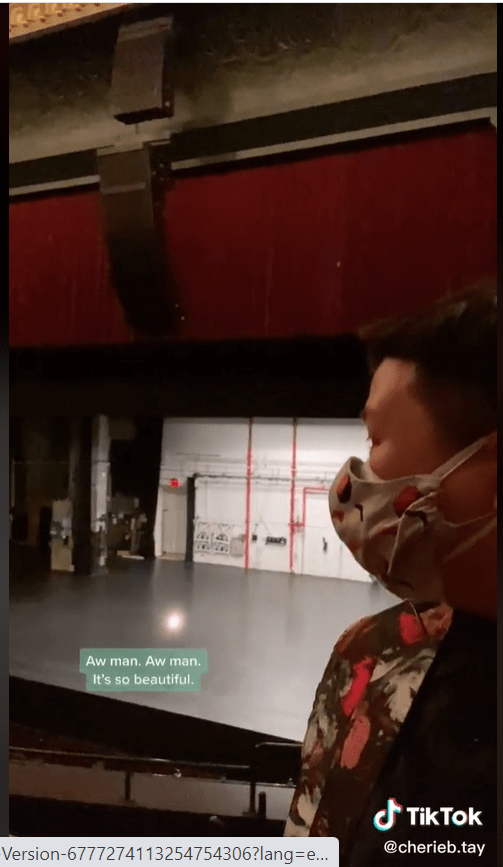
Watching them, I became homesick. Mind you, I’ve never been to their theatre but there is something about a theatre space that is universal. I commented that I missed the special silence of an empty theatre. An empty theater is pregnant with possibility of what is just about to happen of what could be.
I’m also sad because of what the theatre industry didn’t get to do. So many productions that may never happen now. Artists that had to leave the industry and will never come back. Also, because we will never get to see what happened with Jubilee 2020. One of my favorite things about the theatre community is how it never rests. There are always artists pushing it to be better, to be more. Working in the arts, I was able to see systemic racism by well mean white people and how it was woven into every element of what we do. I learned from listening to artists about what responsibilities I had to change the way we did things. Jubilee 2020 was a way to bring all of the work together as a community and celebrate.
The idea started in 2015 after scandal after scandal of white led theatres making questionable choices in shows performed, casting choices, and more. You can see here what the committee laid out as participation. https://howlround.com/welcome-jubilee Everyone was invited to join.
The idea of Jubilee 2020 is a simple but powerful one.
What if there was a yearlong, nationwide theatre festival featuring work generated by those who have historically been excluded–including but not limited to artists of color, Native American and Indigenous and First Nations artists, women, non-binary and gender non-conforming artists, LGBTQIA2+ artists, Deaf artists, and artists with disabilities?
Flash forward to 2020. Not the year we expected. Yet a year that called on a radical change in all areas of our lives. Especially those affected by race. It could have been a year of transformation led by the Jubilee. Instead, theatres were in enforced silence.
In August, I reached out to theatres in the Chicago area who had committed to the Jubilee. “Now everything has been thrown out of the window because of a pandemic. At the same time, the conversation about BIPOC people is at a level it’s never been before. I was wondering how theatre-makers were feeling.”
Below are responses from three artists. I also want to hear your thoughts. What do you miss about theatre? What do you want from it when it returns?
Director of Programming
Thanks for asking for feedback and thoughts. Here are mine, in no particular order:
To me as a representative of my theatre, the Jubilee has always been about self-accountability, a call to analyze our production history and say, “Whose work are we producing? Who is that work for? How often is the default (cis het male) the gear we drive in?” It asked us to look in the mirror, spot opportunities for improvements with regards to inclusion, and do something about it. And now, in a post-W.A.T. world, that feeling of checking ourselves and changing has never been more prevalent. Suddenly, what the Jubilee asks for isn’t an “opt-in” in our industry; it’s what is becoming very, very expected, and rightly so.
I’d also add, on a more personal level: at the last season planning meeting we had prior to COVID and the proceeding quarantine, the Broken Nose team and I realized that even our track record with producing works that were not written by or for the default (cis het male) had largely improved, to the point where the Jubilee distinction felt unnecessary because it had over the years simply become what we do every year. We are still very on-board with participating, but it no longer feels, to us, like a year as distinctive as it seemed when we signed up years ago.
All this to say, I’m curious if it’s time to reconsider what the Jubilee even means now. If the majority of participants have, like us, made the Jubilee requirements our norm, what further progress can be demanded of us? What is something else the Jubilee can ask us to commit to that would push us further in the realm of D.E.I.?
I don’t have the answers to these questions, of course, but it’s worth asking. Can Jubilee serve a different purpose than was intended for it upon its creation? It’s an interesting conversation to have.
Thanks for letting me share my unedited thoughts, Michelle. I’m very excited to hear what options might be considered and how the program might evolve at a time when so few of us are producing at all, let alone virtually.
Theatre-Creator. Activist. Educator.
The company that had committed to the Jubilee, The Fractal Theatre Collective, was shuttered in July. My Collective had been composed of non-binary individuals, women, Black creators, and other artists of color – we took on the pledge as a natural extension of the work already being done. And yet, we wanted to go beyond the pledge. Jubilee’s focus on programming, and it’s uncomfortable relationship with the gender-binary, limited the scope of the changes we deemed necessary.
Jubilee was something to aspire to at a time when capitalist theaters could obfuscate their resource hoarding and institutional violence through “diversity and inclusion” initiatives, and the few Black faces in high places. Now, the aspirations of Jubilee have become the new normal for the theatrical neoliberal class of creators in this time of international rebellion. These institutions and the individuals that maintain them discovered a convenient goal-post in Jubilee’s call to action, and now rallying around initiatives similar to it that will ensure that the status quo remains intact.
Perhaps we have moved beyond the need for the Jubilee. Perhaps we have moved beyond the necessity for any narrowly tailored, reactionary solution to systemic racism, transphobia, colonialism, capitalism, and anti-Black violence. We See You stands out among the crowd as an attempt to build power and solidarity; however, even then, it stops short of openly challenging the power that keeps the most vulnerable theatre artists left out of a community that veils itself in the performance of progressive political action.
Perhaps we have moved beyond the need for theatre, at this moment. What is socially responsive theatre at a time when your social response should be anti-facsist organizing and continuous anti-racist transformation?
My thoughts were racing. Thank you for providing a platform for me to speak.
Co-founder, Artistic Director
We are heartened by the primacy of representation in conversations throughout American Theatre. How joyous that it seems the goal of Jubilee–which once felt aspirational and targeted one specific season–is now the curatorial default for arts organizations. One group not always mentioned/included is our fellow disabled artists, so we are actively expanding our artistic processes and organizational methodologies to manifest loving space(s) where Access is celebrated. In addition to the question of who, we are very much obsessed with what; which is to say merely swapping out individuals in and out of a paradigm that inevitably nudges everything and everyone towards a corporate structure (and, more dangerously, ethos) sets neither the individuals nor the organizations on a course towards permanent, true change. We are thinking very hard about the benefits of a collapsed vertical structure and will be experimenting with structures which foment centrifugal energies; whirling and circulating points of view from every level and department in order to re-balance organization power pools and de-sexify/de-celebrify the position of Artistic Director in American Theatre.
 MarketingMichelle