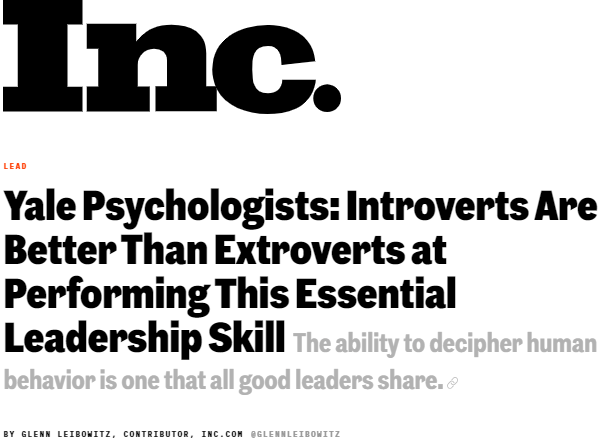
Are you as smart as a social psychologist? If you are an introvert you might be. So claims the study “Social Psychological Skill and Its Correlates” by Anton Gollwitzer and John A. Bargh. Or does it? According to the Inc. article covering the study titled “Yale Psychologists: Introverts Are Better Than Extroverts at Performing This Essential Leadership Skill” by Glenn Leibowitz, introverts as opposed to extroverts, were better at “observing and understanding the social behavior of people in group settings”.
However, I believe there is a flawed premise of the article – that being that the study and the article do not share the same meaning for the word introvert. You would think that I would be calling into question the way that a consumer-minded organization uses the word. You would be wrong. I believe that Inc. is using the definition of introversion as defined by the American Psychological Association (APA) as:
introversion
- orientation toward the internal private world of one’s self and one’s inner thoughts and feelings, rather than toward the outer world of people and things. Introversion is a broad personality trait and, like extraversion, exists on a continuum of attitudes and behaviors. Introverts are relatively more withdrawn, retiring, reserved, quiet, and deliberate; they may tend to mute or guard expression of positive affect, adopt more skeptical views or positions, and prefer to work independently. [concept originated by Carl Jung for the study of personality types] —introversive adj. —introvert n. —introverted adj.
What very little definition that Gollwitzer and Bargh share for their definition of introversion focuses on a single word – loneliness. As is attested to by the Psychcentral article “The Link Between Introversion and Loneliness” there is a complexity of “delightful alone-ness to fretful loneliness”. Our definition source for this paper, the APA suggests this:
loneliness
- affective and cognitive discomfort or uneasiness from being or perceiving oneself to be alone or otherwise solitary. Psychological theory and research offer multiple perspectives: Social psychology emphasizes the emotional distress that results when inherent needs for intimacy and companionship are not met; cognitive psychology emphasizes the unpleasant and unsettling experience that results from a perceived discrepancy (i.e., deficiency in quantity or quality) between an individual’s desired and actual social relationships. Psychologists from the existential or humanistic perspectives may see loneliness as an inevitable, painful aspect of the human condition that nevertheless may contribute to increased self-awareness and renewal. See the UCLA Loneliness Scale.
Loneliness isn’t exclusive to introversion. Introversion does not necessitate loneliness. So from an early point in ready the study, I began to have large questions about the validity of the study and also about the different ways that we interpret introversion especially when dispensing business knowledge as in the Inc. article.
This probably is influenced in part by the fact that I am an introvert. I was having trouble finding a study that captured ideas that I was interested in, such as the importance of art in developing empathy and imposter syndrome, so imagine my delight when I, an introvert, found this Inc. article by simply typing in “new study finds” and “social behavior” into google. Being an introvert is an inescapable part of how I function in the world, so I of course wanted to learn more about a business skill I may have that others don’t. It also explains why I take except to the idea that the main association for these scientists with introversion is loneliness. Many introverts have spent many a conversation with an extrovert trying to explain the difference between being alone and being lonely. Just google “introvert alone vs lonely” and you’ll see that we have quite a bit to say on the topic.
If I were the Inc. article writer, I may have been better served to say that loneliness and low self-esteem are linked to better ability to predict social psychological phenomena. If I were the scientists in the study, I may have been better served to find a different word than “introvert” to describe the behavior I was intending. It was also interesting to see that they are familiar with the cultural ideal of “introvert” as they used the word introspective, which is more descriptive of an introvert’s behavior than a possible side effect or symptom that is loneliness. Again, returning to the APA, we get this definition of introspection as:
n.
- the process of attempting to directly access one’s own internal psychological processes, judgments, perceptions, or states.
- in the literature on attitudes, the process in which a person attempts to explain the reasons for holding a particular attitude, reaching a specific decision, or engaging in a particular behavior. —introspective adj.
But suggesting that business people have worse confidence in themselves in order to have more confidence in their ability to predict social psychological phenomena such as social loafing and attribution effects probably doesn’t fly with their editor. Another way to frame it which also wouldn’t have been as exciting but more accurate to the study would be to share that taking a single class in psychology would significantly weight your ability to predict such behaviors.
I’m quite disappointed to say that I don’t hold water with the claim made by the study and trumpeted by the Inc. article that my introversion makes me better at predicting social psychology behavior or at understanding behavior in group settings. In large part because both sides are playing fast and loose with terminology. Between the Inc. article grabbing onto the buzz word of “introvert” and extrapolating what it meant about observing group behavior, a conclusion that I believe it drew from the mention of social loafing in the study and nothing else, and the scientists using a personality type, introvert, as a stand-in for a feeling, loneliness, and low self-esteem there’s little left to shore up the conclusions drawn by both sides.
Citations
APA Dictionary of Psychology. (n.d.). Retrieved from https://dictionary.apa.org/
Asatryan, K. (2018, July 08). The Link Between Introversion and Loneliness. Retrieved from https://psychcentral.com/blog/the-link-between-introversion-and-loneliness/
Gollwitzer, A., & Bargh, J. A. (2018). Social Psychological Skill and Its Correlates. Social Psychology,49(2), 88-102. doi:10.1027/1864-9335/a000332
Leibowitz, G. (2018, December 31). Yale Psychologists: Introverts Are Better Than Extroverts at Performing This Essential Leadership Skill. Retrieved from https://www.inc.com/glenn-leibowitz/yale-psychologists-introverts-are-better-than-extroverts-at-performing-this-essential-leadership-skill.html
 MarketingMichelle
Loved readingg this thank you
LikeLike